1.7 – Ready to Train! Courses and Curriculum
Courses and Curriculum With the right backgrounds under your belt, and an understanding of the different qualification levels related to the job, let’s take a look at the training that Officials go through, to take the leap from curious about the Code – to enforcing it. Like most kinds of specialized roles in the industry, the training has to be specific to match!
In our Province, training and educational development is handled through the Nova Scotia Building Officials Association – or NSBOA; as the governing body representing all Building Officials – if you’re looking to become qualified, you’ll need to work through their professional studies program, completing a wide number of courses – on a variety of subjects. Training can happen in a number of different formats (like this course! Online, in person, and a combination of both) – so be sure to take advantage of whichever options work best for you!
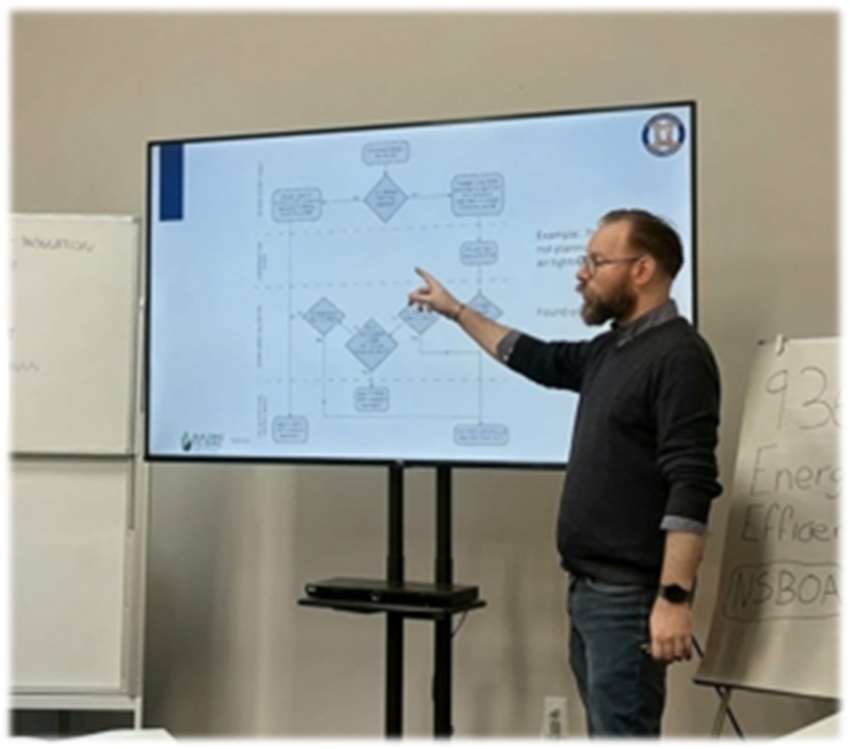
For example; part of being a Building Official means understanding the legislation (the laws) that enacts the Code – so, an introductory Legal course is part of that training. Building Officials also need to communicate with industry, creating reports, completing inspections, and participating in discussions about Code compliance – so a Communications course is also included. While these might not seem like the most “Code” focused courses – a good understanding of the tools and language used by the Official can’t be overlooked!
Because they also need to understand the different applications of the Code, courses also cover topics like Plumbing (as it applies to Houses), HVAC – or Heating, Ventilation, and Air Conditioning (as it applies to houses), Energy Efficiency in building design, design requirements for Houses, and design requirements for Small Buildings (including structure, fire protection, and exiting – and where those requirements differ from building type to building type), and the requirements of Barrier-Free Design – so that all people are able to access and use those spaces.
We’ll talk a bit more about the different types of buildings in later Modules – so keep an eye out for that – but it’s important to note that some topics (like barrier-free design) apply to almost all types of buildings that the Official can review – so, these courses are very important when it comes to providing fundamentals for the Officials’ training!

As we’ve mentioned previously, the more complicated the building – the more complex the requirements within the Code are that apply to it. Officials working towards higher levels of qualifications will need to undergo education about these differences through a series of three courses; Large Buildings:
this course covers the general requirements for all buildings over 3 storeys in building height – regardless of use; basically, our introduction to larger, more complicated buildings in the broadest sense. Classification and Construction: this course covers the Code requirements that differ between the different uses of a building, and how those different uses (or occupancies – which will discuss later) interact. This course also covers how to help figure out what different uses are, so that you can better apply to Code to them! Complex Buildings: This last course helps us examine some of the most complicated elements in our buildings, as well as the types of uses which require the most attention. This includes things like life safety systems (active ones like fire alarms or sprinklers), hazardous materials (things like flammable or explosive gases and liquids – think distilleries or factories!), and buildings that are classified as Post-disaster – which means that even after hurricanes or floods or other intense weather events, they’re expected to be up and running (because of how important they are to the public). Like the earlier courses, these higher-level subjects all relate to each other, and to a wide range of buildings that the Official might be involved in working on. That’s why it’s so important to have training that covers such a huge number of potential buildings and uses – because there are just so many different needs out there, for construction!
Finally, understanding the Code requirements as they apply to a building also means being able to look at its design and understand not only what is needed for the building to work – but also, that the information given to us in those drawings is correct. In order to ensure that Officials can correctly make that call between compliant, and not – on paper at least, and since review of permit drawings is such a large – and critical part of the Official’s workload, plan review is naturally one of the courses they’ll take. Since buildings fall into different categories – for meeting the Code that is – there are two different courses here; Small Buildings (which is are more simple types of uses – like homes and small offices or retail stores), and Large Buildings (which is everything else – but also our more complex and potentially dangerous buildings).
These two courses round out the list of the Official’s training – but the education doesn’t have to stop there! There are plenty of seminars, lunch and learns, conferences, even online presentations saved to view at your own pace; the NSBOA often provides links to these resources – if they’re something you find of interest! So be sure to keep an eye out for them in your inbox!