
3.8 – Extra Credit: Additional Considerations of the Legislation
Considerations of the Legislation We’ve talked about a significant number of critical functions of the Act, and the Regulations – allowing for adoption, enforcement, and administration of the Codes. Before moving on, however, it’s important to discuss a few more tools in our Official toolbox that these legislative documents provide. The Act, and Regulations give us a lot of additional power, and functionality, past just handing us the Code, after all!
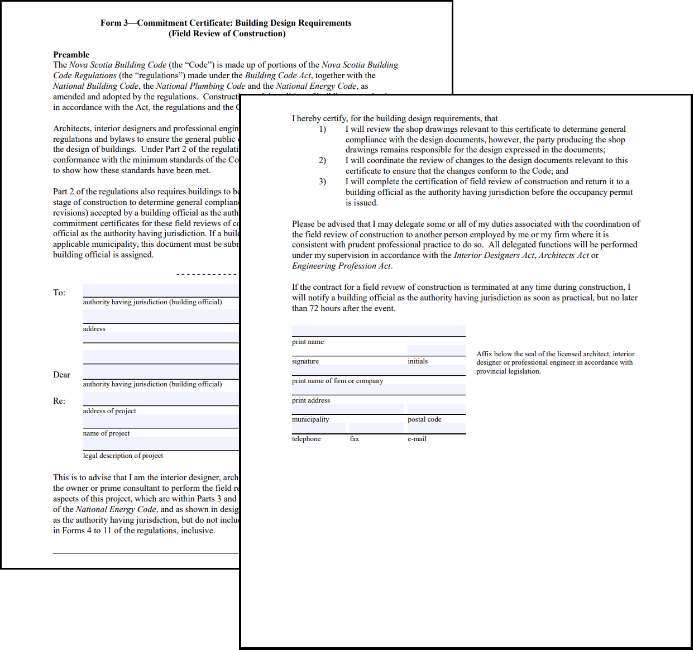
The first, through the Regulations, are the Letters of Undertaking – now sometimes referred to as the Form Letters; these contractual documents are signed by engineers, interior designers, and architects – as appropriate for their individual scope of work on a project. This is immensely valuable to us as Building Officials, because it ensures three key things, within a project.
First, that there is another qualified person conducting inspections on the project – relative to their design. The Official is really just on site for a fraction of the time the building is under construction – let alone the lifespan of the building itself; having additional eyes regularly review progress of different scopes of work, helps to ensure that compliance is being met regardless of when the Official is on site. Second, it is their professional obligation to let us know if the plans change, need revision, or if they note deficiencies during their own inspections. Much like having that second set of eyes, providing their own inspection reports, and keeping the Official aware of any changes that are being proposed can help keep the project – even if it pivots – from being held up or stopped for additional compliance reviews. Third, that following the completion of their scope, they provide us with verification that they’ve ensured compliance with the Code. Sort of a book-end arrangement, that lets us know that from start – through to the finish – that qualified designers have helped to ensure that our Code has been followed. This displaces a great amount of liability from the Official and ensures that Code compliance is being reviewed by a full team – rather than just one person; and truly, construction requires a whole team – as the complexity of a project increases.
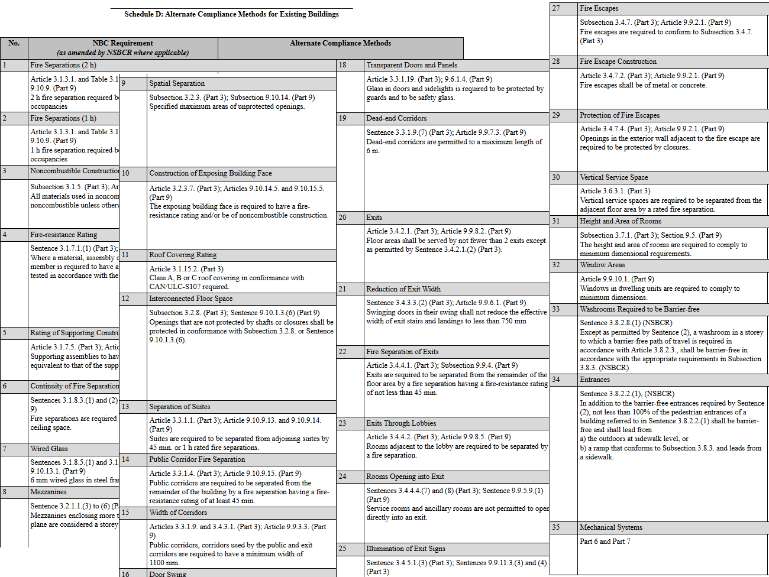
The second, also as part of the Regulations, is a section referred to as Schedule D; this is an alternative compliance method for existing buildings. But unlike the alternative compliance through Performance, like we’ve discussed previously – this section works more closely as concessions for existing buildings.
There are a lot of buildings out there that existed prior to the formal adoption of the Code in this Province and maybe changes to the Code since – this makes it very difficult, in some cases, for renovations to meet the requirements of today – in the framework of yesterday. As we’ve said previously – the Code generally doesn’t work retroactively – because it’s not reasonable for it to do so; buildings aren’t like our phones, or computers – where we can just click a button to update and catch up with the latest design expectations!
This is where Schedule D shines – because it allows for less restrictive solutions, understanding that in many cases, even in not meeting todays’ Code – the alternative it provides would allow for an improvement over what currently is built. They don’t cover everything and certainly can’t be used in place of an unsafe condition – but they do provide a lot of options which would otherwise require an engineer or architect to develop for the builder.
Finally, created through the Act – we have a means for resolving disputes between Officials, and owner, contractors, and designers – should they arise. Through the creation of the Nova Scotia Building Advisory Committee, or BAC – there is a neutral third party – made up various industry members (identified through the Regulations) to listen to disagreements over interpretation of the Code, including Orders issued for non-compliance issued by the Official.
Representing all sides of the construction industry, the BAC is able to weigh the intention of the Code, its impact on the project, and arrive at an agreed outcome. And truly, this is an accurate description of what they do; it’s not simply about reading the black and white of the Code and confirming that a Sentence was correctly identified – they consider what is being objected to, the potential impact of allowing (or disallowing it), the expectations that it could set within industry – even the practicality of compliance. This is helpful for not just the Official, but the other members of the industry as well – because it removes the decision from either party, and presents a mandate for both groups to follow – specific to that one project.
This is an important point – because the BAC is not the same as a court, in that a decision here serves as precedent (meaning, that it sets a ruling that can apply to all future projects); only to the project that is being reviewed as part of the appeal. That doesn’t mean, of course, that Officials might not use this judgement as a way to set policy in their own regions – or, that they might not consider it when reviewing a rule for compliance with the Code, construction as it appears on site, or a proposal for compliance as part of a project, assembly, or other element under their review.