
3.2 – What Does the Act Provide?
As a “framework,” the Act needs to cover a lot of things; we identified a few of them already – including establishing a minimum standard for construction and demolition practices, the responsibility of enforcement, and the requirements around permitting. In fact – it goes far beyond that (for such a small document), in broadly outlining not just the requirements that will need to be created – but even the who and what may be involved in the process.
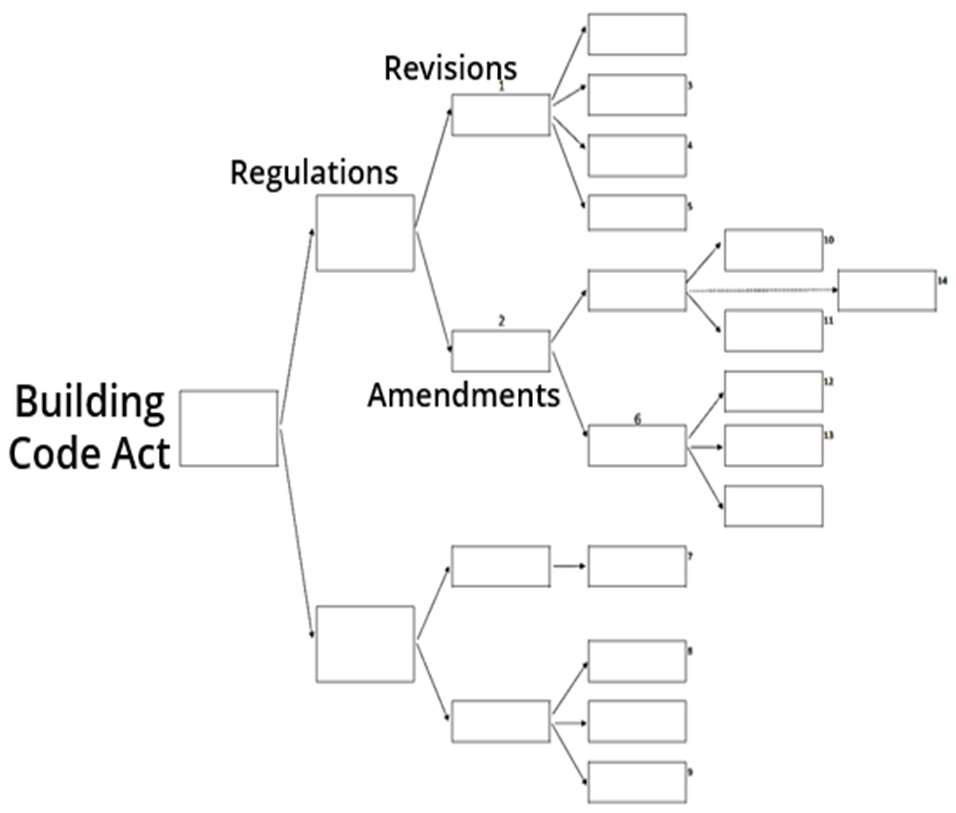
It’s a lot for one document to cover – but the beauty of the Act, as we’ve stated already – is that it can point to many other sources and pieces of legislation, in order to cover what it (essentially) needs to, in order to be our starting point.
Let’s start with the adoption of the Building Code; the Act outlines that this shall take place – but it also establishes that Regulations shall be created, so that this can occur. This is a critical step (and essentially the first) in turning our Code to law – because we depend so much on the Regulations for much of what the Official needs in their toolbox. Moreover, it places the authority to do so in someone’s hands – in this case, the Minister Municipal Affairs and Housing – but that responsibility can be transferred to whichever Minister holds Code compliance within their portfolio (which happens from time to time, as is the case with many pieces of legislation).
Beyond this – it even clarifies the degree to which such Regulations need adopt the Code – whether it be in whole, in part, or with revision – even unto a whole classification of buildings. This means that, through the guidance of the Act, the Regulations created to facilitate the Act can have an immense degree of control over how that adoption takes place. I’m sure this seems like a small matter, but in later parts of the Module, we’ll see just how powerful a feature of the Act (and by its creation, the Regulations) this is.

In establishing the requirement for enforcement to take place, the Act not only outlines where that enforcement needs to come from initially (the Municipality) but also defines the agent on their behalf (in this case, the Building Official), and outlines the requirement for their training, and certification – as well as the board overseeing it – to be established. In other words, what courses, credentials, or otherwise education that it takes for someone to step into the position of an Official.
This means that further regulation needs to be made, to ensure that the enforcement of the Act (through the adoption of the Code), is done so by qualified individuals – through reviewed, and approved training – by a qualified agency – which helps ensure the effectiveness of that enforcement. Again, none of this is outlined by the Act itself – only that the requirement is identified as a requirement by the very existence of the Act itself.

Further to identifying the enforcement by Building Officials, the Act also sets the requirement for the permits themselves; that is, that there is a legislative requirement for a permit application, if someone wishes to build or demolish a building. For every renovation, every addition, every shed or garage, or deck – anything which the Building Code could apply to – there is a mandate to review it through a permit (though, few exceptions do apply). Through that requirement, the Building Official is positioned in the role of issuing those permits.
This creates two important check points for enforcement of the Code – the first, being that a permit is required in order for work to be done – which means failure to do so can result in fines, orders, or prosecution – kind of like getting behind the wheel of your car without a license, or registration. It’s the entry point, from which the Official can issue orders, if necessary, to stop work which otherwise would require oversight.
Secondly, through the review of a permit application, by the Building Official, that the scope of work intended to be done can be reviewed, to ensure that compliance with the Code has occurred – if that ends up not being the case, the permit may be withheld by the Building Official, until enough information to demonstrate compliance is met. While this may not result in any orders – if work has begun, or is ongoing during the review of the application (without the permit being approved), fines and prosecution can still occur; the ultimate goal here, of course, is to ensure that compliance is met (much like in our speed limit sign example), through the potential of what could be the consequence, if a would-be project fails to follow the same rules, as everyone else. Unlike our example of speed limits, and signs – the legislation allows enforcement to occur, even before an infraction occurs – through the initial review (which, largely, is where ensure compliance occurs – before our projects even get off the ground). In our next section, we’ll talk about the Regulations – which take our compliance toolbox further.